
The Signs
Two hundred twenty-six years ago today — October 2, 1800 — a boy was born enslaved in Southampton County, Virginia. They called him Nat Turner. He taught himself to read. He became a preacher. The people around him called him “the Prophet.”
And in August of 1831, he led the deadliest slave rebellion in American history — and the state spent the next two centuries trying to make you forget his name.
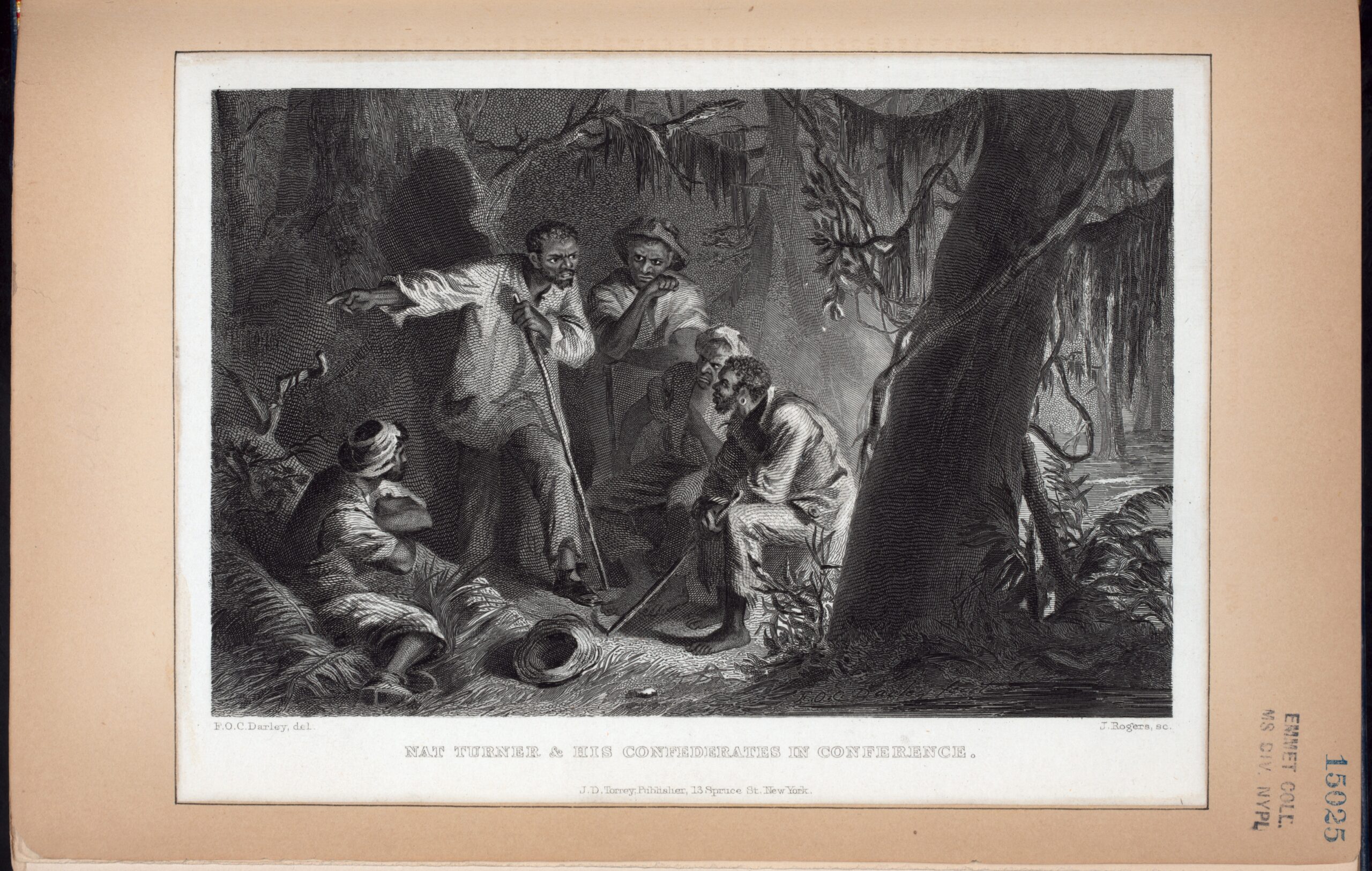
Nat Turner believed God spoke to him in visions. He said he saw signs in the sky and heard a voice calling him to a holy war against slavery.
The sign he’d been waiting for came on February 12, 1831: an annular solar eclipse darkened the Virginia sky. NASA’s own eclipse records note that Turner witnessed it and took it as a vision — a “black angel” overtaking a “white angel.” He began to organize.
Then, on August 13, 1831, the sun appeared bluish-green — a haze in the atmosphere, scholars believe, from a volcanic eruption in the Mediterranean. That was the final signal.
He had originally planned to rise on July 4, 1831 — because of the irony, obviously. July 4th. In a slave state. The date slipped, and the rebellion began the evening of August 21.
Forty-Eight Hours
Turner and roughly seventy enslaved and free Black followers moved through Southampton County for about two days. They killed 55 to 65 white people — men, women, children — sparing only a handful of homes, including one poor white family who owned no enslaved people. It remains the most deadly slave revolt in United States history.
Then it ended almost as fast as it started. The state militia and armed white residents crushed it within 48 hours. Turner escaped into the woods. He hid near his enslaver’s farm — not in some faraway swamp, but right there in Southampton County — for about ten weeks, living in the ground like a ghost while armed men hunted him.
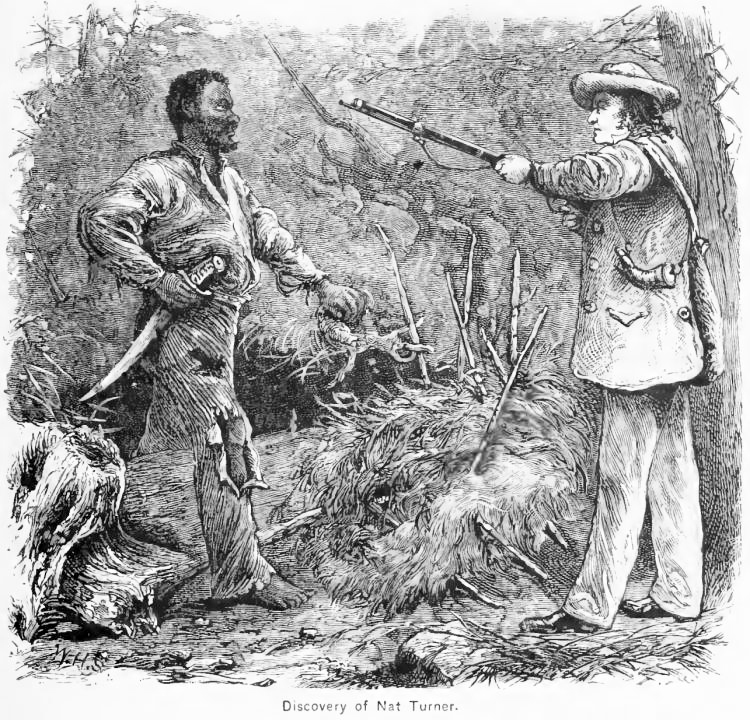
On October 30, 1831, a farmer named Benjamin Phipps found him hiding in a depression where a tree had fallen, covered with fence rails. Turner reached the Jerusalem jail on October 31. He was tried on November 5 for “conspiring to rebel and making insurrection,” convicted, and hanged on November 11, 1831.
After they killed him, they flayed his body, beheaded him, and quartered him. His torso was buried in the pauper’s cemetery. What happened to his head became one of American history’s strangest mysteries: a skull said to be Turner’s was passed through private hands for generations, and in 2016 it was handed over to the Smithsonian for DNA testing. No result has ever been publicly confirmed. National Geographic put it bluntly: “the facts surrounding Turner end and speculation and lore begin.”
The Confessions — and Who Really Wrote Them
In jail, a local white lawyer named Thomas R. Gray interviewed Turner and rushed a pamphlet into print by the end of November: The Confessions of Nat Turner. It has been read, reprinted, and argued over ever since.
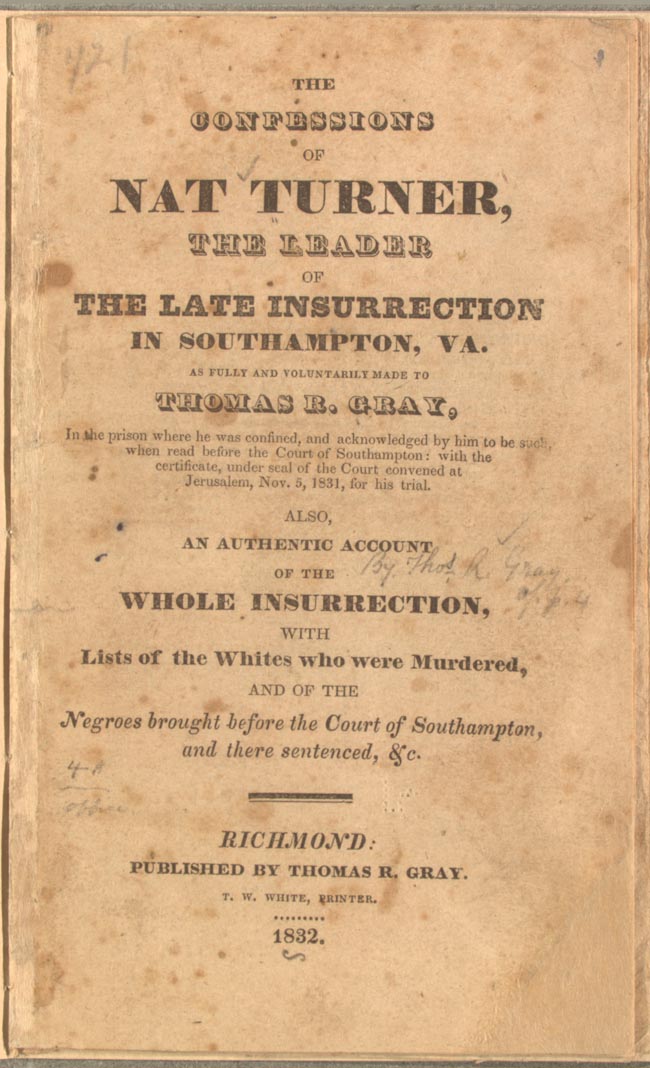
But here’s the problem: Gray was the same age as Turner, he represented some of the other accused rebels, and scholars have spent nearly two centuries debating how much of the Confessions is Turner’s voice and how much is Gray’s framing. Legal historians have argued it was designed, at least in part, to justify harsher repression. When Gray asked Turner if he saw himself as mistaken now, Turner answered: “Was not Christ crucified?”
That’s in the text. Whose sentence it is — Turner’s or Gray’s — is a question nobody will ever fully settle.
What Virginia Did Next
The rebellion terrified the entire South. And for one brief, remarkable moment, Virginia’s legislature actually considered ending slavery. In January and February of 1832, delegates debated gradual emancipation — openly, on the record. Delegate James McDowell said what everyone was thinking: “It was the suspicion eternally attached to the slave himself, the suspicion that a Nat Turner might be in every family.”
It failed. The pro-slavery side won, armed with a fresh defense of slavery published by the president of William & Mary. It was the last time Virginia’s legislature would consider emancipation until the Civil War.
And then the state chose the other option. Virginia criminalized teaching Black people — enslaved or free — to read and write. Black religious gatherings were restricted to those with a licensed white minister present. Free Black people were targeted for relocation. Abolitionist publications were criminalized. Other Southern states followed.
Read that again: the response to a rebellion led by a man who read the Bible and preached was to make reading and preaching illegal. They understood exactly what Nat Turner was. That’s why they tried to erase him.
The Terror Numbers Nobody Wants to Say
The reprisals were savage. Modern historians agree that militias and mobs killed as many as 120 Black people in the aftermath — most of them uninvolved in the rebellion at all. Estimates in the scholarship run from two dozen to more than two hundred. The exact number is unknowable, because nobody in power was counting Black lives that month.
A severed head was displayed at a Southampton crossroads. The road is still called Blackhead Signpost Road. In Wilmington, North Carolina, panicked whites beheaded six Black people and mounted their heads at the city entrances. One spot was called Negro Head Road into the 1940s.
That was the state’s answer to 48 hours of rebellion: terror, and then silence.
The Erasure
Here is a fact that tells you everything about how this country handles Nat Turner: no authentic portrait of him exists. Not one image drawn from life. The famous engraving you’ve probably seen — “Discovery of Nat Turner,” showing Phipps finding him — was made by an artist born nine years after the rebellion. It isn’t a portrait. It’s an imagination.
For generations, Southampton County had Confederate monuments and barely a plaque for the largest slave rebellion in American history. The graves remain unmarked. A preliminary dig near the purported burial site in 2016 found human bones, and still the ground won’t give up its secrets.
But erasure failed. The Nat Turner Library — founded in 1998 on Turner’s birth land in Drewryville, Virginia, claiming the world’s largest collection of books about him — still holds annual Nat Turner Day celebrations. The Turner Trail marks the rebellion’s sites. His name survived two centuries of a state trying to bury it, because you cannot legislate a story out of people.
Why October Remembers Him
Two hundred twenty-six years after his birth, Nat Turner’s story lands in a season when the fights he was part of are still being fought. The same state of Virginia that criminalized Black literacy in 1831 now argues over which books belong in school libraries. The same country that displayed severed heads at crossroads still argues over whether teaching this history makes children uncomfortable.
Nat Turner read the sky and decided freedom was worth dying for. The least we can do is remember his name on his birthday.
BH365 fact file: Nat Turner (1800–1831). Born October 2, 1800, Southampton County, Virginia. Led the August 21–23, 1831 rebellion — the deadliest slave revolt in U.S. history (55–65 killed). Captured October 30, 1831; hanged November 11, 1831. No authentic portrait exists.
Discover more from The Whitsdom Press
Subscribe to get the latest posts sent to your email.
Leave a comment