
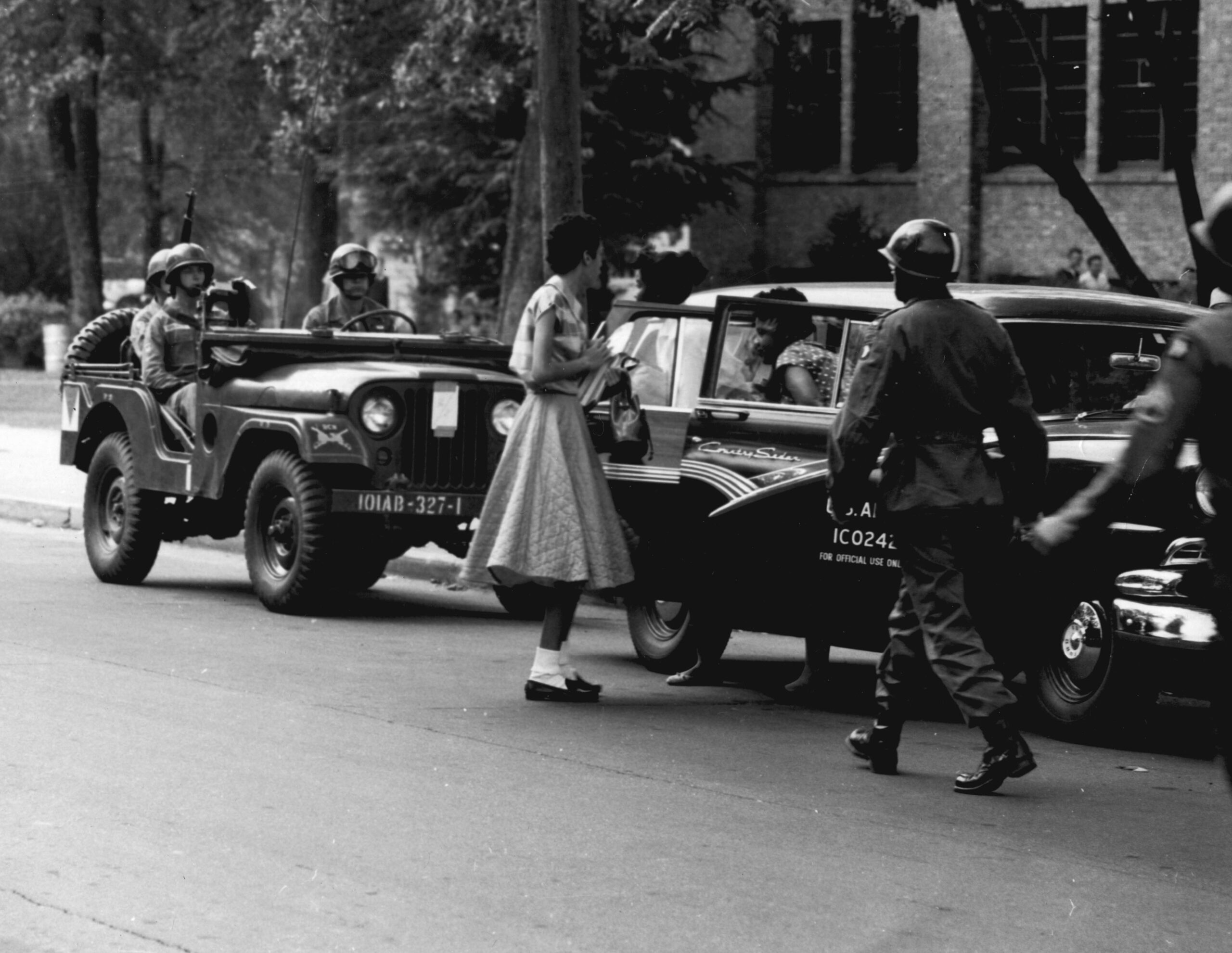
Sixty-nine years ago today, nine Black teenagers walked up to Central High School in Little Rock, Arkansas, with a federal court order behind them. Outside the school, about a thousand white segregationists had gathered — jeering, threatening, filling the street around the building. The nine students made it inside. They did not get to stay. Before noon, police pulled them out of the school and sent them home for their own safety. September 23, 1957, is the day the mob won.
But that is only half the story — the mob’s half. The other half belongs to the people who stood behind those nine teenagers: the organizer who coordinated every move, the families who sent their children into danger anyway, and the Black journalists who walked the hallways beside them. The Little Rock Nine never walked alone. Their community made sure of it.
Elizabeth Walks Alone
To understand September 23, you have to start on September 4. Three years after Brown v. Board of Education declared school segregation unconstitutional, Little Rock’s schools were still segregated — and when the Nine tried to enter Central High that morning, Governor Orval Faubus had ringed the building with the Arkansas National Guard. The soldiers weren’t there to protect the students. They were there to keep them out.
Elizabeth Eckford, fifteen years old, walked up to that line alone. Her family had no telephone, so the meeting plan the other students had agreed on — to arrive together — never reached her. She faced the guardsmen, and then the crowd, by herself. The mob closed in around her, and some in it threatened to lynch her. She made it to a bus stop, where a white woman, Grace Lorch, stepped beside her and stayed with her until she was safely on a bus.
The Community That Stood Behind the Nine
The Nine were teenagers, but teenagers were never running this operation alone. Daisy Bates — president of the Arkansas NAACP chapter and co-publisher of a Black newspaper with her husband — coordinated the group. She vetted the students, organized them, and sat with their parents through every impossible decision. And the families themselves made the hardest choice a parent can make: to send a child into a mob, and trust that history was worth the risk.
On September 23, four Black journalists walked into Central High alongside the students — going in not just to report the story, but to stand inside it. When the official record of that morning gets written, remember who was in the hallway: police and troopers, yes, but also a community that refused to let nine teenagers face a thousand-person mob by themselves.
Inside Before Noon — Then Gone
On the morning of September 23, the Nine slipped into Central High through a side door, escorted by city police and state troopers. The mob outside — roughly a thousand strong — didn’t know they were inside. Not at first.
Then word got out, and the crowd turned riotous. Outside the school, the situation was spiraling — and inside, the call was made to get the students out before somebody got killed. Police evacuated the Nine before noon, spiriting them away in official vehicles. The students had done nothing wrong. The mob had. But the mob is what got its way that morning.
The Night the President Acted
That same evening, President Dwight D. Eisenhower issued a formal proclamation ordering everyone obstructing integration in Little Rock to “cease and desist.” The warning landed the way warnings do: ignored.
The next day, September 24, Little Rock’s mayor sent Eisenhower a telegram asking for federal help. Eisenhower answered with force. He federalized the entire Arkansas National Guard — taking Faubus’s troops out of Faubus’s hands — and deployed 1,000 paratroopers from the 101st Airborne Division to Little Rock.
On September 25, the Nine walked into Central High under armed guard — past the mob, past the jeers, into their classrooms. As the story has been told ever since: they didn’t carry weapons. They carried books.
Why Little Rock Still Echoes
The story didn’t end at the schoolhouse door. In May 1958, Ernest Green became the first Black student to graduate from Central High. That same year, the Nine received the NAACP’s Spingarn Medal. And Faubus, rather than accept integration, shut down Little Rock’s high schools for an entire year — the “Lost Year” — denying an education to Black and white students alike before the schools finally reopened.
Little Rock still echoes because the questions it raised never went away: who gets a fair shot at a good school, whose history gets taught and whose gets taken off the shelf, and who the power of the state protects when a crowd gathers. In Texas, where school boards still fight over textbooks and classroom equity, those questions aren’t history. They’re this week’s agenda.
On September 23, 1957, the mob won the day. The Nine were sent home before noon. But two days later they were back — books in hand, soldiers at their backs, a whole community behind them. Little Rock proved something America keeps having to relearn: rights on paper are only as real as the people willing to defend them.
Discover more from The Whitsdom Press
Subscribe to get the latest posts sent to your email.
Leave a comment