
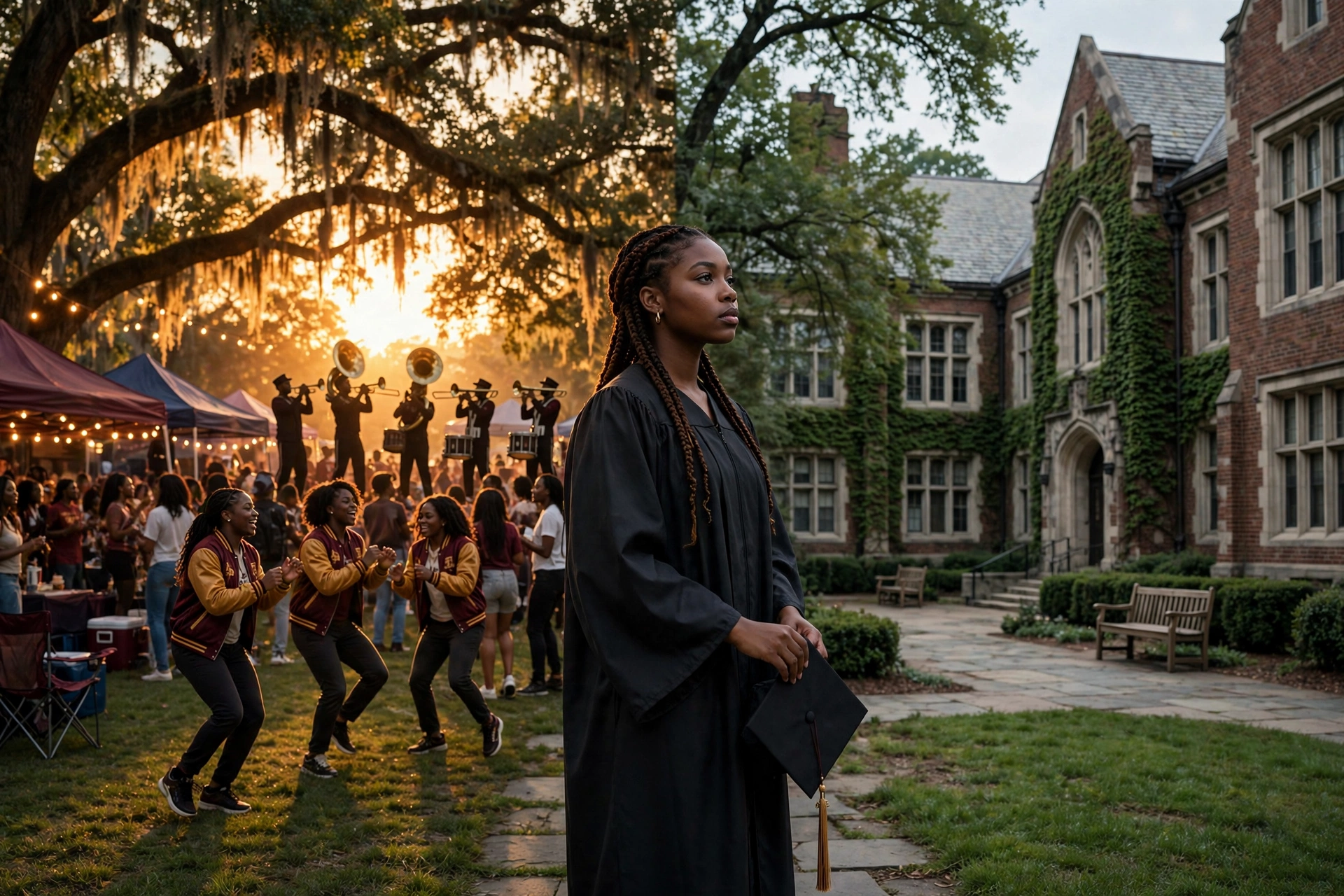
It’s homecoming season, y’all.
Every fall, right on schedule, my timeline fills up with marching band clips, probate season videos, and those gold-link homecoming flyers. And with it comes the argument. The same argument. It never takes a year off: who really owns the Black college experience?
Somewhere in the Black community, there has always been a divide between those of us who attended PWIs — predominantly white institutions — and those who attended HBCUs — historically Black colleges and universities. And every October, that divide turns into a full-blown debate, complete with gatekeeping, guilt trips, and thinly veiled insults about who is really down and who is just passing through.
I know, because I live in the middle of it.
Let me tell you my story, because context matters. I got accepted into a whole lot of HBCUs. That was the dream route — or at least the one everybody expected me to take. But I ended up at a PWI in Texas. Why? The money, plain and simple. The PWI offered me more funding, and anybody who has ever stared down a tuition bill knows that funding is not a small detail — it is the detail. It wasn’t a rejection of my Blackness. It was a practical choice, made with real-life math. And here’s some context most people don’t expect: I attended historically Black elementary, middle, and high school. Then I transferred to a high school that wasn’t historically Black — and that transfer is what prepared me for the PWI more than anything else.
And since we’re being honest about what PWIs are really like, let me tell you what my years there actually looked like. Our community of Black students was close — genuinely close. We looked out for each other. We weren’t walking around campus afraid of being attacked by the opposition; we were too busy building something together. I was a member of the Black Student Caucus, and that space — our space — held me down. I’ll say it plain: my experience as a Black student at the college I attended was not bad. Not perfect, because nowhere is. But not bad.
And yet, I have had Black people who attended HBCUs look me in the eye — or worse, in my mentions — and tell me that people like me shouldn’t pull up to HBCU homecomings. That we should stop “cosplaying the Black college student experience.” Cosplaying. As if my degree, my friendships, my all-nighters, and my growth were a costume I put on for the culture.
Let me be clear: the receipts on this argument are public, and they go back years. Here are the flashpoints that keep this debate on life support:
A few years ago, Black students at UCLA started a hashtag, #HBCULA, jokingly referring to their school as an HBCU — a way of celebrating the tight-knit community they’d built as a tiny fraction of the student body. HBCU students pushed back hard. The message, as reported by Her Campus, was blunt: if HBCUs weren’t good enough for you to attend, don’t come to our homecomings, and don’t you dare call your PWI an HBCU.
Then the same thing happened at the University of Louisiana Monroe with #HBCULM. Same joke, same celebration, same firestorm. Her Campus covered that blowback, too.
Then there was the viral Facebook debate where a Central State University alumnus said he felt “sorry” for the college experience of Black students who went to PWIs. PWI grads fired back — and they did not hold back — defending their Black cultural centers, their Divine Nine chapters, their own Black homecomings, and the Black faculty who poured into them. HBCU Buzz reported the whole back-and-forth.
And every couple of years, Andscape picks up the thread with the recurring question: do HBCUs actually educate Black students better than PWIs? The data gets debated, the comments get heated, and nobody’s mind ever changes. But the wound gets reopened.
A young Black woman on Facebook got honest about choosing a PWI in Massachusetts after growing up in the suburbs — and being told she was “whitewashed” for it. The comments split wide open on identity and assimilation. Watch it on Facebook.
A Fort Valley State alumnus put it plain: the only way to legitimately weigh in on HBCU issues is to have attended one. Watch his reel on Instagram.
And Tiffany D. Loftin — a verified creator who leads the US Student Association and works with the Mississippi NAACP — just laid out what’s actually happening to our students right now. It’s longer than three minutes, but it’s worth every single second. Watch her reel on Instagram.
But let me tell you what we should actually be talking about. Because while we’re over here arguing about who belongs at homecoming, our Black students are getting priced out of college entirely. And I don’t mean that as a metaphor.
Tiffany broke it down plain: students are being purged from campuses over financial aid gaps. A senior staring down an $11,000 payment gap just to finish her last year. A California student who can’t cover tuition after her Pell funding got cut. Four students losing their Pell eligibility entirely under the new rules. Changed loan caps that mean students can’t even borrow enough to stay enrolled. These aren’t talking points — these are real babies being told to pack up and go home because the money ran out.
And it’s not happening by accident. She called it exactly what it is: an explicitly loud attack on higher education. This administration already said out loud that they want to shut down the Department of Education. There are proposals to tax private institutions — including HBCUs tied to race — in ways that could strip their 501(c)(3) status. A 100-page Department of Education proposal to rewrite accreditation standards, going after even the American Bar Association, which would put federal aid at risk for I don’t know how many students. This isn’t drift. It’s demolition.
And as if that weren’t enough, with the midterms coming up, young people are running into voter registration barriers and showing up to campuses with no polling sites. So they don’t want us in the classroom, and they don’t want us at the ballot box either. You tell me what that adds up to.
So no — I don’t have the energy for the HBCU-versus-PWI homecoming wars. Not when our students can’t afford to be on anybody’s campus. While we’re busy gatekeeping the yard, Black students are getting priced out of school completely. THAT is the fight. Everything else is just noise.
Now, before anybody gets it twisted — let me say this plainly: HBCU pride is real, and it is earned. The bands. The yard. The legacy of institutions built when nobody else would educate us. The way homecoming feels like a family reunion and a cultural revival at the same time. I respect all of it. I’ve felt the pull of all of it. Nobody can take that away, and nobody should try.
But here’s the part that doesn’t get said enough: the Black PWI experience is real, too. Try being 3% of the campus population and building community from scratch. Try finding your people in a sea of faces that don’t look like yours. Black student unions. Divine Nine lines crossed at PWIs, where stepping and strolling carry the same weight and the same work. Navigating white spaces every single day — in classrooms, in dorms, in group projects — while still holding on to yourself. That is not a watered-down version of Blackness. That is Blackness under pressure, and it builds something in you.
Here is the deeper point I keep coming back to: there is no single “Black experience” to cosplay, and there is no single “Black experience” to protect. College choices are driven by funding and family realities — by scholarship letters, by legacy, by proximity to home, by who is helping you pay for it. Turning those choices into a loyalty test is a distraction. It keeps us policing each other instead of asking why the funding gaps exist in the first place, why HBCUs have been underfunded for generations, and why any Black student has to choose between cultural affirmation and financial survival.
Blackness is not a costume you put on. It is also not a credential that gets revoked at the homecoming gate.
So here’s my invitation, from one Black college grad to all the rest of us: come to homecoming. Seriously, come. Dance, tailgate, hug everybody’s auntie. But come correct. Come with respect for the legacy of that yard — not as a tourist collecting content, but as family showing up for family. And if you see somebody there whose degree says PWI, remember: they’re not cosplaying anything. They’re just Black, and they’re home.
Discover more from The Whitsdom Press
Subscribe to get the latest posts sent to your email.
Leave a comment