
One hundred seven years ago today, roughly one hundred Black farmers gathered at a church in Hoop Spur, outside Elaine, Arkansas, to talk about the cotton they had picked and the money they were owed. That was the crime.
Not a robbery. Not a riot. A meeting. The farmers had formed a union — the Progressive Farmers and Household Union of America, founded by Black sharecropper Robert L. Hill — which hired a white Little Rock lawyer, Ulysses S. Bratton, to take the plantation owners to court.
The 1919 cotton crop was the most profitable in history. The sharecroppers who picked it were among the poorest people in America. That gap was not an accident. It was the system.
The System They Were Up Against
In Phillips County, Black people outnumbered whites ten to one, but white landowners owned everything that mattered. They sold the cotton on their own schedule, ran the plantation stores, and settled accounts in lump sums with no itemized statements. An unwritten law said a sharecropper could not leave a plantation until his debts were paid. The debts never got paid.
Hill’s union was built to break that machine the legal way: fair accounting, honest settlements, lawsuits if necessary. In 1919, Black farmers negotiating as equals was treated as an attack — so that night, the farmers posted armed guards outside the church doors.
The Shot That Started It
Late that night, two deputized white men and a Black trustee arrived at the church. Shots were exchanged — a Missouri Pacific railroad policeman, W. D. Adkins, was killed and a deputy sheriff, Charles Pratt, wounded. It was never determined who fired first. It didn’t matter. By morning, the sheriff had called for white men from Arkansas and Mississippi to come hunt Black residents. A mob of five hundred to a thousand armed white men began shooting Black people on sight across the county — men, women, children. Arkansas historian Michael Dougan put it plainly: “If it was black and moving, it was target practice.”
The newspapers did their part. The New York Times ran the headline “Planned Massacre of Whites Today.” The Arkansas Gazette called Elaine “a zone of negro insurrection.” There was no insurrection — there had been a union meeting.
When the Government Joined In
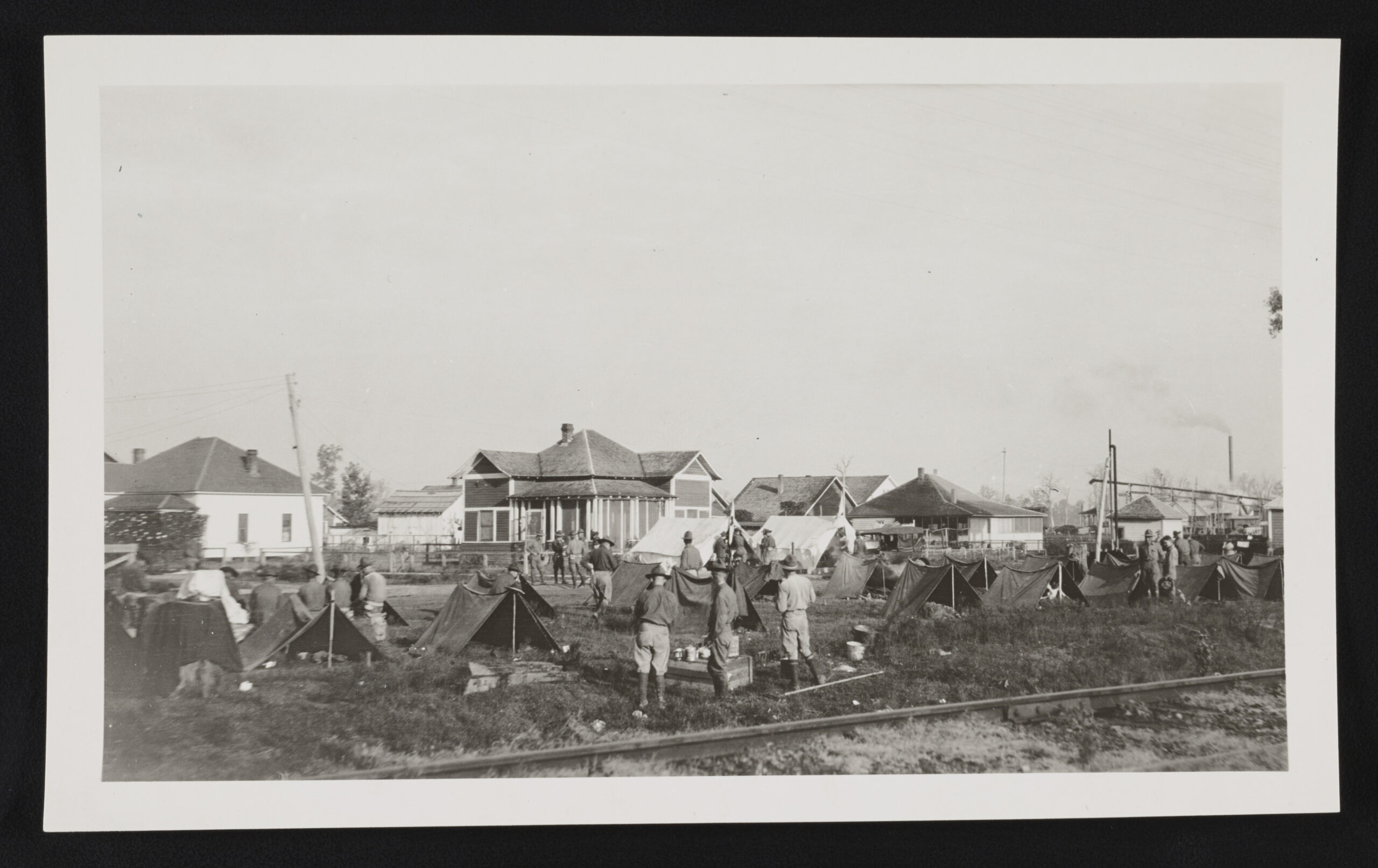
Governor Charles Hillman Brough didn’t send investigators. He sent nearly six hundred federal troops from Camp Pike, with a machine-gun battalion, under orders — as the Arkansas Democrat reported — to “shoot to kill any negro who refused to surrender immediately.”
The soldiers did not restore order. They joined the hunt. Eyewitnesses swore the troops took part in the indiscriminate killing. The Army admitted to two. The real number died with the bodies the state buried.
The killing went on for three days. Black World War I veteran Leroy Johnston — nine months in a French hospital recovering from trench wounds — was pulled off a train on his way home and shot dead alongside his three brothers.
The Honest Number
Nobody knows how many Black people were murdered at Elaine: historians say 100 to 237, the Smithsonian says at least 200, the NAACP’s investigator estimated up to 400. The Army admitted to two.
They called it a “race riot.” A riot is two sides fighting. This was one side with guns, badges, and federal troops, and the other side hiding in the woods. The Encyclopedia of Arkansas calls it “possibly the bloodiest racial conflict in the history of the United States.” The Equal Justice Initiative classifies the Black dead at Elaine as lynching victims.
The Cover-Up
Brough appointed a Committee of Seven: seven prominent white businessmen who never spoke to a single Black farmer. Their conclusion: the union was a “socialist enterprise” established “for the purpose of banding Negroes together for the killing of White people.” Brough then asked the Post Office to ban the Chicago Defender and the NAACP’s Crisis from Arkansas mail.
But the truth got out. The NAACP sent its field secretary, Walter White — a Black man with blond hair and blue eyes who could pass as white — into Phillips County with press credentials. He got the real story, barely escaped alive, and published it in the Daily News, the Defender, and The Nation. Ida B. Wells took the sharecroppers’ statements in their own words.
The Twelve and the Case That Changed the Law
The state’s revenge was the courtroom. An all-white grand jury indicted 122 Black people. Prisoners were beaten, whipped, and tortured with electric shocks until they confessed. Twelve Black men — the Elaine Twelve — were convicted of first-degree murder by all-white juries and sentenced to die. No white person was ever charged with anything.
Then Scipio Africanus Jones stepped forward — born enslaved in Arkansas, he had taught himself the law. He took the twelve condemned men’s cases when almost no one else would, survived lynching threats, and wrote the brief that carried the fight to Washington. The NAACP’s Moorfield Storey argued it before the U.S. Supreme Court.
In 1923, the Court decided Moore v. Dempsey. Justice Oliver Wendell Holmes wrote that when “the whole proceeding is a mask” and a trial is swept along “by an irresistible wave of public passion,” the Constitution’s promise of due process means nothing. For the first time, a federal court struck down a state criminal conviction because the trial had been dominated by a mob.
Six went free; six were retried and sentenced to twelve years — until Jones got the last of them out in 1925. Robert Hill had fled to Kansas, where the governor refused to extradite him, saying he would not be safe or fairly tried in Arkansas.
Why You Never Learned This
They never taught us about Elaine because the story indicts everyone who told it — the planters, the press, the governor, the troops, the courts, and the textbooks that called a massacre a “riot” and moved on.
But here is what Elaine was: working people, cheated out of the most profitable cotton crop in history, sitting in a church and demanding an honest accounting. The deadliest racial violence in American history did not start because Black people were violent. It started because Black people were organized.
They were not rioters. They were union members. And they were right.
Discover more from The Whitsdom Press
Subscribe to get the latest posts sent to your email.
Leave a comment