
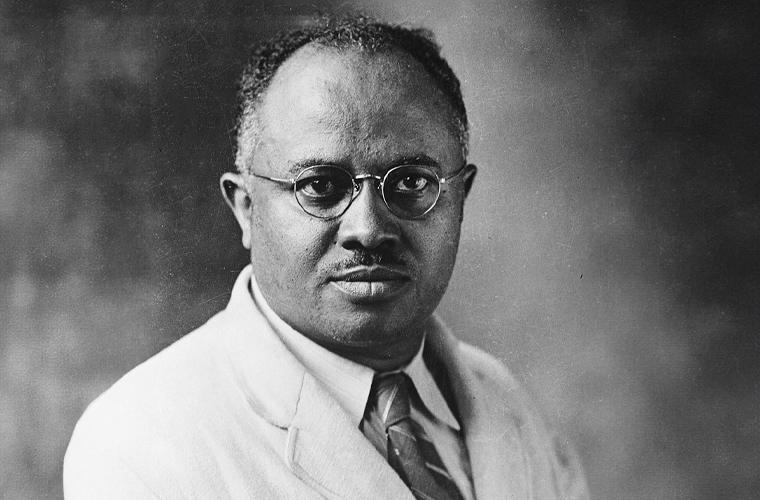
One hundred thirty-two years ago today, a boy was born in segregated Baltimore who would grow up to be the first Black president of the American Sociological Association — and the scholar who remapped how America thinks about Black family life. His name was E. Franklin Frazier, and he did something radical for his time: he studied Black people as people, not as a problem.
In an era when white scholars wrote the definitive books about Black life, Frazier wrote his own. He gathered data, he named causes, and he argued — with receipts — that the shape of Black family life came from history and economics, not from nature. For that, he won national awards, led the country’s top sociology organization, and took fire from every side. Black history is full of people who fought; Frazier fought with a typewriter, and his aim was precise.
A Baltimore Boy in a Segregated City
Edward Franklin Frazier was born on September 24, 1894, in Baltimore, Maryland, one of five children. His father, James H. Frazier, worked as a bank messenger; his mother, Mary Clark Frazier, kept the home. The schools were legally segregated, and the doors beyond them were narrow. Frazier walked through them anyway.
He graduated from the Colored High and Training School in 1912 and carried a scholarship to Howard University, where he finished in 1916 with honors — studying Latin, Greek, German, and mathematics, and serving as class president. From there he earned a master’s degree in sociology at Clark University in 1920 and a doctorate at the University of Chicago in 1931, becoming the first African American to earn a sociology PhD there. His dissertation was published in 1932 as The Negro Family in Chicago — the seed of the book that would make his name.
The Essay That Ran Him Out of Atlanta
Before the fame came the exile. In 1927, while teaching at Morehouse College, Frazier published an essay in Forum magazine called “The Pathology of Race Prejudice.” His argument was blunt: racial prejudice wasn’t a disagreement or a tradition — it was analogous to insanity. A sick mind lashes out; a sick society does the same.
The backlash was swift and dangerous. The essay drew threats, and Frazier had to leave Atlanta for his own safety. But here’s the thing about silencing a scholar with a point: he just keeps writing. Frazier taught at Fisk University from 1929 to 1934, and in 1934 he took the chair of Howard University’s sociology department, a post he held for a quarter-century, until 1959.
Mapping the Black Family
Frazier’s landmark book, The Negro Family in the United States (1939), grew out of his dissertation and traced the Black family from slavery through the Great Migration and into the cities of the mid-1930s. His thesis reshaped the field: slavery had eroded patriarchal family structures, and the families that emerged after emancipation — and reshaped again by urban migration — were shaped by economic and historical pressures, not by biology or inherent defect.
It was also a direct challenge to prevailing academic wisdom. Anthropologist Melville Herskovits argued that African cultural traditions survived strongly in Black American life; Frazier pushed back, arguing that slavery had largely destroyed those traditions and that American Black life was being remade under American conditions. The debate between them defined the field for a generation. The book won the 1940 Anisfield-Wolf Book Award for the most significant work on race relations — and it was among the first sociological works on Black people that was researched and written by a Black person himself.
The Critic of the Black Middle Class
Frazier saved some of his sharpest words for his own people. In Black Bourgeoisie (1957), he argued that the Black middle class was caught in a trap of “make-believe” — status-seeking, conspicuous consumption, and a desperate hunger for acceptance that diverted energy away from the fight for racial equality. Success on paper, he said, was no substitute for freedom.
The book was dynamite. The Black press and Black intellectuals argued about it fiercely — some said he was airing dirty laundry, others said he was telling the truth nobody else would say. Frazier never muted his stance. He believed comfort could become complicity, and he said so in print.
First of His Kind, Still Shaping the Debate
In 1948, Frazier was elected the first Black president of the American Sociological Association — then called the American Sociological Society. Two years later, he helped draft UNESCO’s statement The Race Question, an international declaration that took apart the pseudoscience of racial superiority. From Baltimore’s segregated classrooms to the world stage, in one lifetime.
His work on family structure fed the national conversations that came after him — including the fierce debate around Daniel Patrick Moynihan’s 1965 report The Negro Family: The Case for National Action, which drew on Frazier’s research to argue about the state of Black families in America. Whether scholars agreed with Frazier or argued against him, they argued on ground he had cleared.
Frazier died in Washington, D.C., on May 17, 1962, at the age of 67. Howard University’s School of Social Work named its research center for him — the E. Franklin Frazier Research Center opened in 2000 — so new generations of Black scholars would do their work in a building carrying his name.
One hundred thirty-two years after his birth, the conversations about Black family life still run through Frazier’s terrain: how history shapes the home, who gets to define “normal,” and whose research counts. He proved that Black life deserved to be studied with rigor — and that Black scholars should be the ones holding the pen. Rights and research on paper are only as real as the people who fight for them, and E. Franklin Frazier fought with everything he had.
Discover more from The Whitsdom Press
Subscribe to get the latest posts sent to your email.
Leave a comment