
One hundred and fifty-eight years ago today, hundreds of Black Georgians did exactly what this country told them to do. They voted. They organized. They marched — peacefully, twenty-five miles — to a political rally in a little town called Camilla.
They were met with gunfire.
This is the story of the Camilla Massacre. And if you’ve never heard of it, that’s not an accident either.
They Won the Vote — Then Got Voted Out of the Legislature
Here’s the setup. The Civil War is over. Georgia’s new 1868 constitution gives Black men the right to vote. Black Georgians do what free people do: they elect their own. Thirty-three Black men — the Original 33 — win seats in the Georgia legislature.
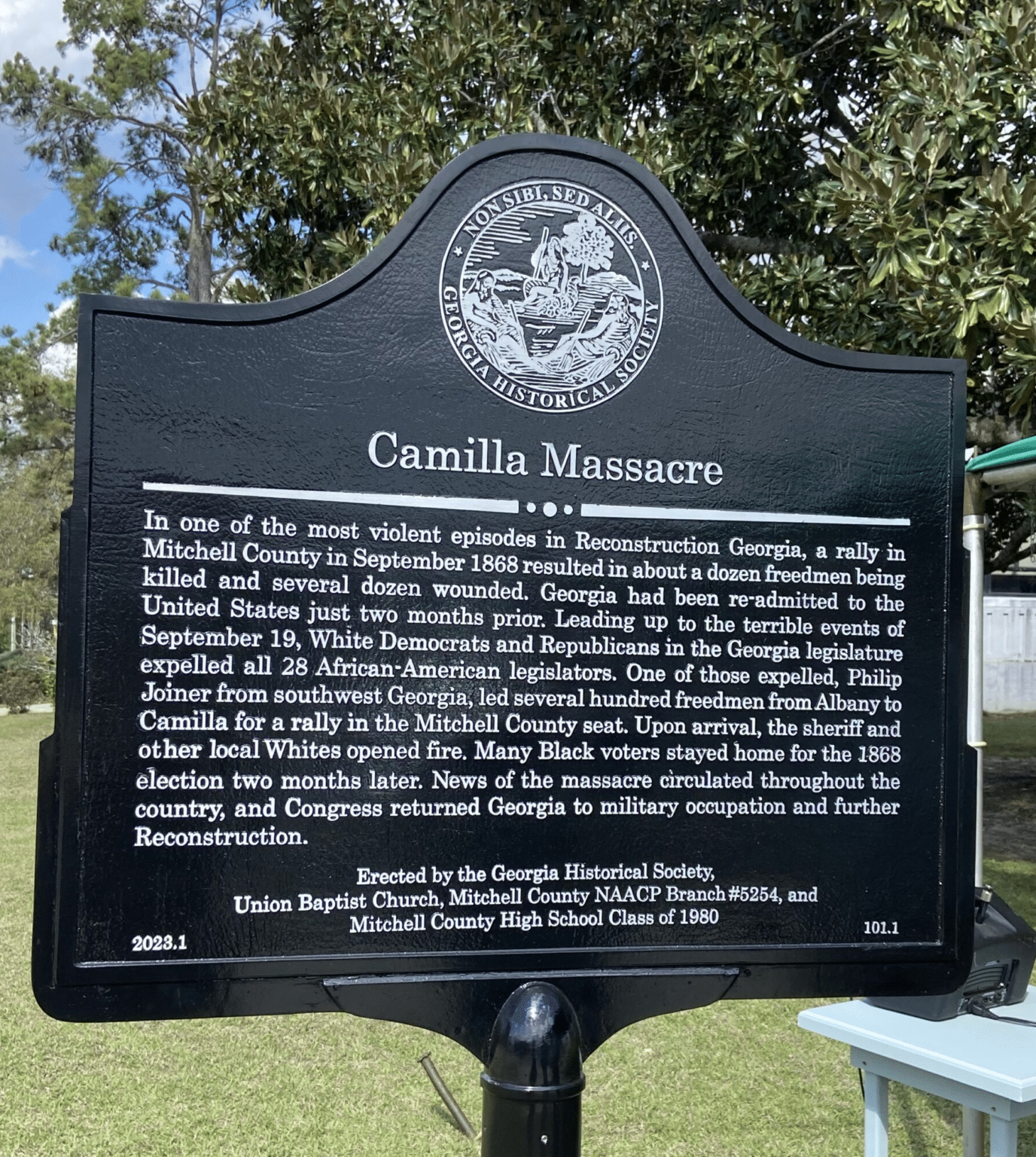
White legislators take one look at their new colleagues and decide democracy was a mistake. In early September 1868, they expel 28 of the Black members. The Georgia Historical Society’s official marker confirms the number: 28.
Let that sink in. Duly elected. Expelled for being Black.
The March to Camilla
One of the expelled men, Philip Joiner of southwest Georgia, refuses to go quietly. On Saturday, September 19, 1868, he leads several hundred freedmen — plus a handful of white Republican allies — on a 25-mile march from Albany to Camilla, the Mitchell County seat, for a Republican political rally.
They carry guns. Not to start a fight — to survive one. The Ku Klux Klan is already terrorizing Black voters across the South, and everybody on that road knows it.
They never make it to the rally.
The Ambush
As the marchers enter Camilla’s courthouse square, the local sheriff and a “citizens committee” of white townsmen — many quickly deputized — open fire from storefronts and rooftops. The marchers scatter. The gunmen chase survivors into the swamps and hunt them through the countryside for two weeks, beating and warning Black families that they’ll be killed if they dare vote in the coming election.
The toll: an estimated 9 to 15 Black marchers dead, around 40 wounded. Not a single white attacker killed or seriously hurt. And nobody — nobody — was ever punished for it.
The Message Worked
Two months later, the November 1868 presidential election arrives. Terrified Black voters across southwest Georgia stay home. The suppression works exactly as designed.
But the news travels. The massacre makes national headlines. Congress is so alarmed that it puts Georgia back under military occupation and restarts Reconstruction there. The Freedmen’s Bureau alone had recorded 336 cases of murder or assault with intent to kill against freedmen in Georgia that year — Camilla was the bloodiest headline in a year of terror.
Erased for 130 Years
Here’s the part that should make your blood boil: for 130 years, Camilla barely acknowledged what happened. No marker. No memorial. Nothing in the textbooks. It wasn’t until 1998 — 130 years later — that the town publicly commemorated the victims, and the official Georgia Historical Society marker didn’t go up until 2023.
One hundred and fifty-five years to get a plaque.
Why This Matters Right Now
The throughline from Camilla to today is not subtle: when Black political power rises, the response is suppression — sometimes with guns in 1868, sometimes with purged voter rolls and shuttered polling places in 2026. The tactics evolve. The target doesn’t.
The people of Camilla marched 25 miles for the right to be heard. The least we can do, 158 years later, is say their names and tell the truth about what happened to them.
Discover more from The Whitsdom Press
Subscribe to get the latest posts sent to your email.
Leave a comment