On April 3rd, 2018, I gave birth to the biggest blessing who changed my life tremendously. She was born prematurely, and I was already prepared for what her diagnosis could be. In January 2020, she was officially diagnosed with Autism. However, she had already been in Speech, Occupational, Feeding, and Physical therapies for 9 months before her diagnosis. Through the years, with patience, resources that were within reach, and the best Facebook group for supporting Black mothers of autistic children… my daughter has blossomed with her speech, physical capabilities, and more. She climbs like Spiderman and can be chatty on occasion like DeeDee from Dexter’s Laboratory (full words). 😂 She has become quite the prankster around the house, and has taught herself how to make beats on her DJ app, play Super Mario Brothers, and sing (she will only sing when she’s by herself, so don’t expect a show.) Yes, she has her “sounds” and yes she gets annoyed at certain sounds, but she is a very courageous and inquisitive child AND I WILL FIGHT THE WORLD FOR HER. Yes, being a caregiver is stressful because you’re always concerned about next steps, the what ifs, and who will help. But the journey is only for those with the ability of being mentally strong and compassionate.
So now you know my story of being a mom of a child with Autism. Let’s talk about why the month of April is important to this specific group of people.
Why April Matters (For Everyone)
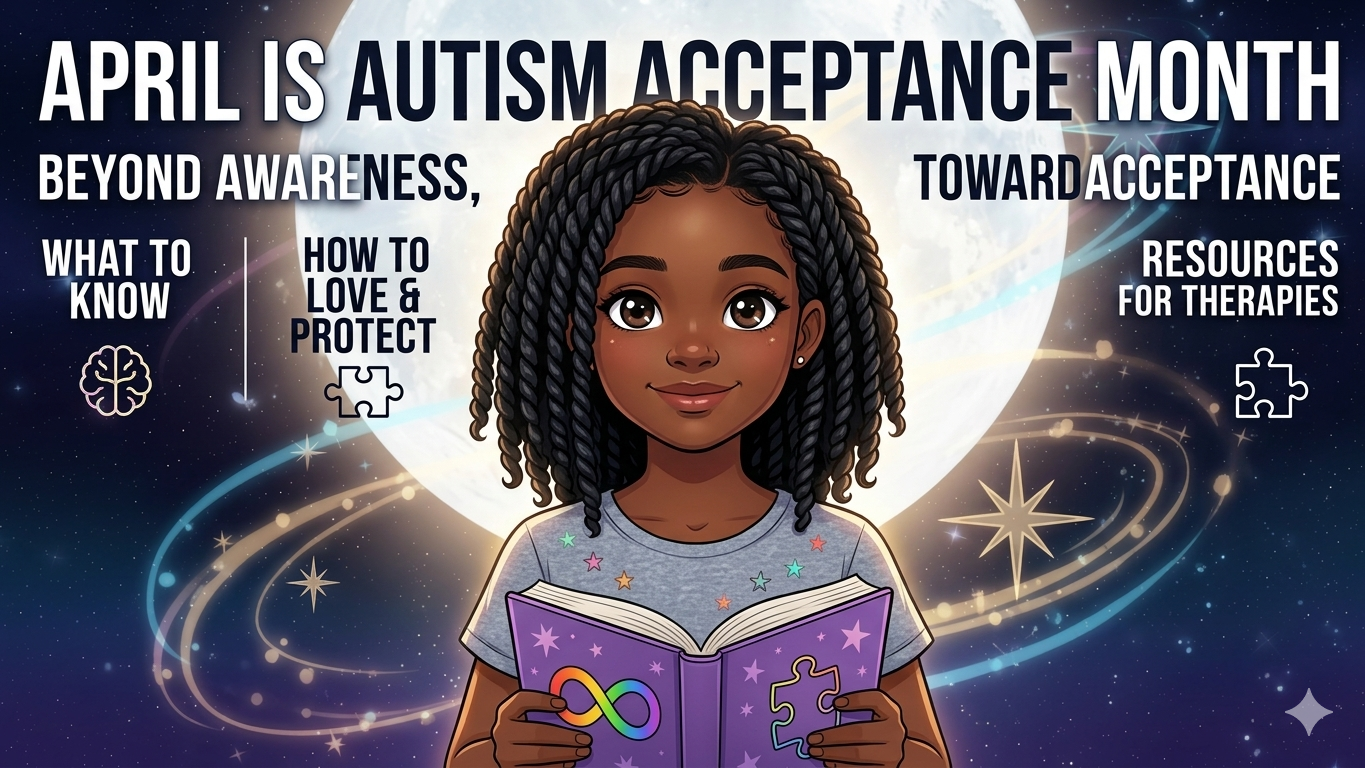
Every April, the world turns a shade of blue and gold for Autism Acceptance Month. You might see the puzzles and the ribbons if you aren’t a parent of an autistic child. You might wonder what it’s really about. For years, we focused on “awareness.” Now, as a mom in the thick of it, I’m seeking something deeper: acceptance.
To Those Who Don’t Quite “Get It” Yet
You might have grown up hearing autism described as a “mental illness.” Some even described it as “childhood schizophrenia.” I want to gently invite you to update that perspective.
Autism isn’t a disease to be cured or a broken mind. It is a neurodevelopmental difference. Her brain is simply “wired” differently. It’s like an iPhone running a different operating system—it’s not broken; it just processes data through a different lens. When she has a meltdown, she isn’t “acting out.” She isn’t “crazy.” Her nervous system is simply overloaded by a world that is too loud, too bright, or too fast.
1. The Spectrum: It’s Not a Line
One of the biggest misconceptions is that kids are “a little” or “very” autistic on a straight line. In reality, it’s a color wheel.
- For Parents: You know that your child has “spiky” skills—maybe they can solve a 500-piece puzzle but struggle to tie their shoes.
- For Others: Stop looking for a “norm.” Seeing a child who is non-speaking doesn’t mean they aren’t intelligent. Presume they are competent and listening, because they usually are!
2. Behavior is Communication
When you see a child flapping their hands or spinning in public, that isn’t a symptom of illness—it’s regulation.
*Parents: Celebrate those “stims”! If they aren’t hurting themselves, let them move. It’s their peace.
- Allies: Instead of staring or judging, offer a smile. That “sound” she’s making is her way of processing joy or stress. It is her voice.
3. Therapy is About Support, Not “Fixing”
We aren’t trying to make our kids “less autistic.” We are trying to give them the tools to thrive in a world that wasn’t built for them.
| If you see… | Understand that… | The Goal is… |
| A child using a tablet to talk | This is AAC (Alternative Communication). | To give them a voice, even without speech. |
| A child wearing headphones | The world is physically painful to their ears. | To help them feel safe in public spaces. |
| A child playing alone | They are often “parallel playing” and enjoying your company. | To connect on their terms, not ours. |
4. How You Can Help in 2026
You don’t have to be a parent to be an ally. True acceptance happens in the small moments:
- Protect Privacy: Don’t film a child’s hard moments for social media “awareness.”
- Check Your Language: Move away from words like “suffering from autism.” My daughter isn’t suffering; she’s exploring, singing, and beat-making!
- Listen to Autistic Adults: Organizations like the Autistic Self Advocacy Network (ASAN) are run by the people who actually live this life. They are the best teachers.
Final Thought: Different is Not “Less”
This April, I challenge you to look past the medical labels. My daughter is a prankster, a rising DJ, and a Spiderman-climbing warrior. She has taught me more about mental strength, patience, and compassion than anyone else ever could.
“Autism… offers a chance for us to glimpse an awe-filled vision of the world that might otherwise pass us by.” – Dr. Colin Zimbleman
To the parents: I see your strength. To the neighbors: I ask for your grace. Let’s make this world a “safe harbor” for all our kids.
If you’re a parent looking for a place to vent, dream, and track your progress, check out my Ausome Parent Journal (Paperback or e-Book). And for a beautiful tribute to the neurodivergent spirit, listen to Papa Wolf the Mage’s album ‘Tism—created with love for our “Ausome” daughter.
How are you choosing to see the “Awe” in Autism this month?