
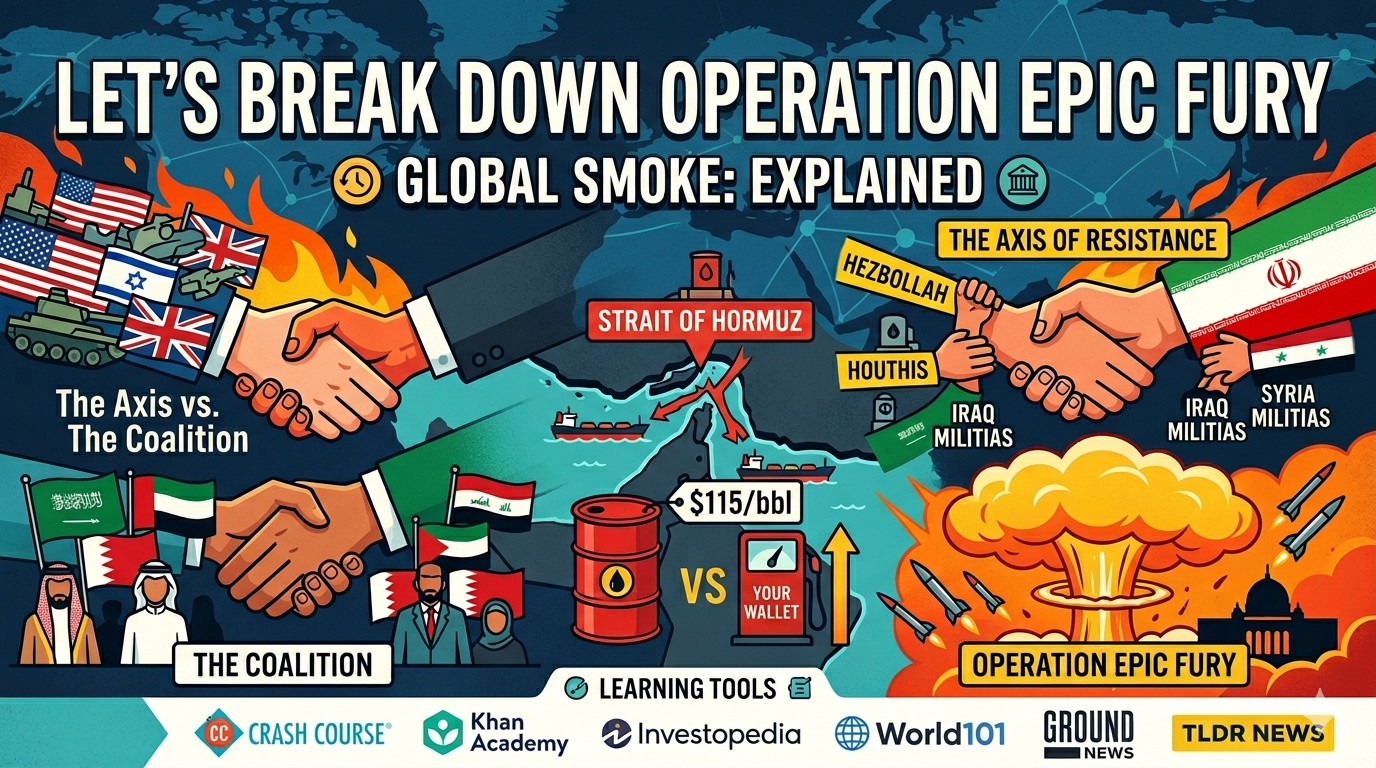
The world of international politics can feel like a high-stakes soap opera where everyone has smoke (or issues; conflict) with everyone else. If you’ve been seeing headlines about the 2026 war in Iran and felt completely lost, don’t worry.
Here is the “Dummies Guide” to what is happening, who is involved, and why the price of gas is suddenly acting crazy.
1. The Core Conflict: What Just Happened?
In late February 2026, the United States and Israel launched a massive joint military operation (called Operation Epic Fury) against Iran.
- The “Why”: The U.S. and Israel argued that diplomacy had failed and that Iran was on the verge of building nuclear weapons. They also cited Iran’s support for regional “proxy” groups (smaller armies Iran pays to fight its battles).
- The Result: The opening strikes were a shock to the system. They targeted Iran’s top leadership, resulting in the death of Supreme Leader Ali Khamenei. His son, Mojtaba Khamenei, has since taken over.
2. The Players: Who’s Got “Smoke” and Who’s an Ally?
Think of this like a global group chat where the factions are clearly divided.
Faction A: The “Coalition” (U.S. & Israel)
- The Goal: Stop Iran’s nuclear program and change the way the country is run (Regime Change).
- Allies: Most Western powers and several Arab Gulf states (like Saudi Arabia, the UAE, and Bahrain). While these Arab nations didn’t necessarily want a full-scale war, they have long-standing rivalries with Iran and view them as a threat.
Faction B: The “Axis of Resistance” (Iran & Friends)
- The Goal: Push the U.S. military out of the Middle East and destroy the state of Israel.
- Allies: This is where it gets complicated. Iran uses “proxies”—groups they fund and train—to fight for them:
- Hezbollah (Lebanon): Iran’s most powerful friend. They have been launching missiles into Israel from the north.
- The Houthis (Yemen): The group currently attacking ships in the Red Sea to disrupt global trade.
- Militias in Iraq & Syria: Smaller groups that have been attacking U.S. military bases in the region.
3. The “Strait” of the Problem: Why Your Gas Prices Are Up
You may have heard of the Strait of Hormuz. It’s a tiny strip of water that 20% of the world’s oil passes through every single day.
- The Smoke: In retaliation for the attacks, Iran effectively closed this “chokepoint.”
- The Consequence: Because ships can’t get through, oil prices shot up over $100 a barrel. This is why “international finance” isn’t just for Wall Street—it’s why your commute to and from work just got more expensive. Yes, $3.69 in Houston.
4. International Politics “The Easy Way”
To understand the future, you have to look at the past.
- The History: This “smoke” goes back to 1979 (the Islamic Revolution). Before that, the U.S. and Iran were actually allies, but a revolution changed Iran’s government to one that viewed the U.S. as the “Great Satan.”
- The Current Vibe: Right now (mid-April 2026), there is a temporary ceasefire brokered by Pakistan. Everyone is currently sitting at a table trying to figure out if they can agree on a “Tiffany deal”—a massive economic package to convince Iran to stop its nuclear program in exchange for money and trade.
How to Stay Informed (The “Non-Expert” Way)
To make sure you aren’t just getting one side of the story—or worse, falling for “fake news” during a fast-moving conflict—you need a solid rotation of news engines. In 2026, the best way to stay informed is to use a mix of “Big News” for breaking facts and “Independent Analysts” for the deep context.
Here are the top news engines and tools to keep in your daily rotation:
1. Ground News (The “Bias Checker”)
If you only use one tool, make it this one. Ground News doesn’t just give you the story; it shows you who is reporting it and how they are leaning.
- Why it’s elite: It has a “Blindspot” feature that shows you news stories the “Left” or the “Right” are ignoring. When a missile strike happens, you can see how media in the U.S. is reporting it versus media in the Middle East.
- Best for: Seeing the full picture and avoiding “smoke and mirrors.”
2. Reuters & The Associated Press (The “Fact-First” Engines)
Most news outlets actually buy their news from these two. They are the “wholesale” of news.
- Why they’re elite: They focus on “Who, What, When, and Where” with very little “opinion.” If you want to know if a ceasefire was actually signed without the political commentary, go to the Reuters World feed.
- Best for: Pure, unflavored facts.
3. Al Jazeera English (The “Regional Perspective”)
Since the conflict is in the Middle East, it helps to read from a source based in the region.
- Why it’s elite: Al Jazeera provides on-the-ground reporting in Iran, Lebanon, and Yemen that Western journalists often can’t access. It helps you see how people living there are experiencing the war.
- Best for: Understanding the “Axis of Resistance” side of the story.
4. The “Financial Times” (The “Money” Engine)
If you want to know how the war is going to affect your pocketbook, the Financial Times (or the WSJ) is where you look.
- Why it’s elite: They follow the money. They aren’t interested in the politics as much as they are in the oil prices, the shipping lanes in the Red Sea, and global inflation.
- Best for: Seeing how global finance is reacting to the fighting.
5. TLDR News (The “Social Media” Engine)
For those who don’t have time to read 2,000-word articles, TLDR News is the best engine for “news for the rest of us.”
- Why it’s elite: They have specific channels for Global, US, and EU news. Their daily newsletters and videos are the perfect “Cheat Sheet” for catching up during your morning coffee.
- Best for: Keeping up-to-date daily without getting overwhelmed.
The Bottom Line: International politics is just a series of long-term grudges and money disputes. Once you know who is friends with whom, the headlines start to make a lot more sense.
Discover more from The Whitsdom Press
Subscribe to get the latest posts sent to your email.
Leave a comment