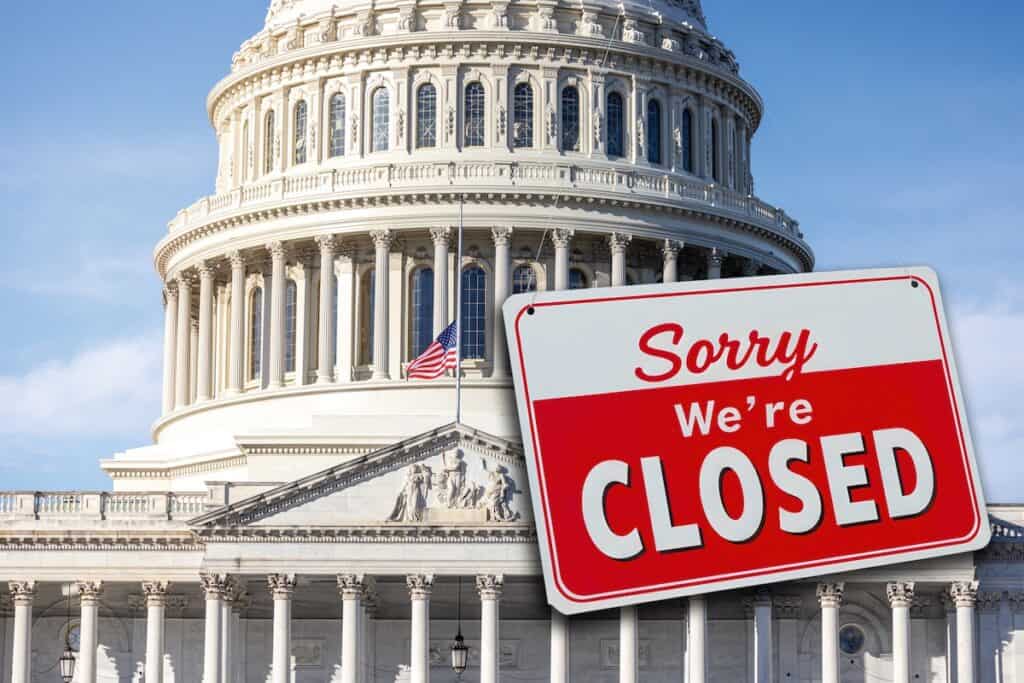
The US Capitol with a closed sign hanging from the dome. The concept explores the federal government shutdown as a result of Congress not being able to pass a budget.
How Many Days Are We In The US Government Shutdown?
As of today, Wednesday, November 5, 2025, the US federal government has been in a shutdown for 36 days.
This closure began on October 1, 2025. It has broken the record to become the longest government shutdown in United States history.
A Grim Milestone: Longest on Record
This shutdown officially surpassed the previous record of 35 days, which occurred from December 2018 to January 2019. This means the political impasse has now created the most prolonged interruption of government services the nation has ever faced.
🛑 Why Is the Government Shut Down? The Core Conflict
A government shutdown happens when Congress does not pass the required appropriations (spending) bills. Alternatively, it can occur if they fail to approve a temporary Continuing Resolution (CR) to fund federal agencies. The new fiscal year begins on October 1st.
The current, record-breaking standoff is rooted in a fundamental disagreement over healthcare spending:
- The Democratic Stance: Democrats in the Senate have a key demand. Any funding bill should include an extension of enhanced subsidies for the Affordable Care Act (ACA). These subsidies were expanded during the COVID-19 relief efforts and help millions of Americans afford health insurance. They are set to expire soon.
- The Republican Stance: Republicans control the House and have a slim majority in the Senate. They have refused to include the ACA subsidy extension. They insist that a “clean” Continuing Resolution—one without policy changes—must pass first to reopen the government.
Because neither side has conceded, funding lapsed, and all non-essential government operations ceased, leading to the current closure.
📉 What Has Changed Among Americans? The Economic and Social Toll
A protracted shutdown affects far more than just Washington politics. It creates significant disruption and economic damage across the country.
Economy and Jobs
| Impact Area | Change/Effect During Shutdown |
| Federal Workers | About 900,000 federal employees face difficult conditions. Some have been furloughed, meaning they were sent home without pay. Others are deemed “excepted” and are required to work without a paycheck. This includes TSA agents, air traffic controllers, and FBI staff. |
| Economic Output (GDP) | The Congressional Budget Office (CBO) estimates the shutdown is already costing the U.S. economy billions of dollars in lost Gross Domestic Product (GDP) that may never be recovered. |
| Data Blackout | The release of critical federal economic statistics—including major reports on employment, trade, and GDP—has been delayed. This data vacuum makes it harder for businesses and investors to make informed decisions. |
| Small Businesses | Federal contract work is paused. Billions of dollars in payments are at risk for private-sector contractors. This is particularly concerning for small businesses that rely on government checks. |
Social Services and Public Health
- Food Assistance (SNAP): Millions of low-income Americans rely on the Supplemental Nutrition Assistance Program (SNAP), commonly known as food stamps. These individuals have faced major uncertainty. Although some emergency funds have been released, the timely delivery and full funding for this essential program remain in jeopardy.
- Healthcare Costs: The political fight centers on the Affordable Care Act (ACA) subsidies. If they expire, millions of Americans using the federal marketplace could see their health insurance premiums increase significantly. On average, there could be a spike of 26%—a massive financial burden.
- Air Travel Safety: Staffing shortages and financial stress have impacted essential but unpaid workers. These workers include air traffic controllers and TSA officers. This situation has led to warnings of mass flight delays. There are potential safety risks and operational reductions at major U.S. airports.
- Childcare and Education: Over 65,000 children across multiple states and territories risk losing access to Head Start early education programs. This loss will disrupt childcare for low-income families. It will force parents out of the workforce.
Conclusion: A Costly Political Deadlock
The current 36-day government shutdown is not a result of a financial crisis. It is not due to an external emergency. It is, instead, a self-imposed political stalemate. Hundreds of thousands of public servants are missing paychecks due to this deadlock. Essential services for millions of vulnerable Americans, ranging from food aid to affordable healthcare, are being disrupted. The longer this record-breaking closure continues, the deeper the economic and social consequences will be.