
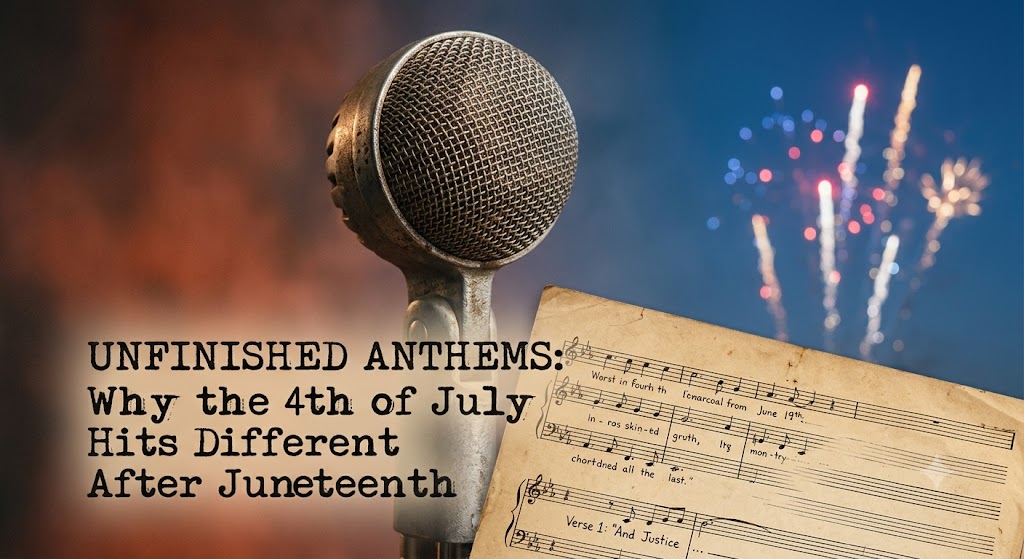
The charcoal from June 19th is barely cold by the time the fireworks for July 4th go up. For Black Americans, these two weeks on the calendar bring a heavy dose of emotional whiplash. In mid-June, we gather in the park, line up for parades, and lift our voices to celebrate Juneteenth—a holiday honoring a hard-won, delayed freedom that we had to claim for ourselves. Then, just a couple of weeks later, the rest of the nation fires up the grills, waves the red, white, and blue, and demands we sing along to anthems about the “land of the free.”
But as a Black woman sitting here in 2026, looking out at the landscape of our country, I have to ask a hard question: Are we actually living the lyrics to those songs? Or are we still singing an unfinished anthem?
To find the answer, we have to look past the soaring melodies and hold the lyrics up to the light of both our history and our modern reality.
Verse 1: “And Justice for All…” vs. The Criminal Justice System
We’ve all heard the promise of liberty and justice for all. But when the foundations of this country were laid, Black people weren’t part of the “all”—we were legally property. Even when the 13th Amendment finally abolished slavery, it left a massive, dangerous loophole: involuntary servitude was still perfectly legal as a punishment for a crime.
That single loophole birthed an era of convict leasing, Jim Crow laws, and a system of policing designed to control Black bodies rather than protect them.
Fast forward to 2026. The chains may look different, but the system is working exactly as it was designed. We live in a nation of mass incarceration where Black Americans are disproportionately policed, arrested, and handed harsher sentences than their peers for the exact same offenses. We see a predatory cash bail system that locks people up not because they are guilty, but because they are poor. When the scales of justice are heavily weighted by the color of your skin and the size of your wallet, singing about “justice for all” feels less like a celebration and more like a cruel irony.
Verse 2: “For Fruited Plains…” vs. The Hungry
America the Beautiful paints a gorgeous picture of a land of abundance—of “purple mountain majesties” and “fruited plains.” It’s a song about a land that overflows with wealth and harvest. The truth is, Black people spent centuries clearing those mountains and working those plains, building the foundational economic wealth of this country with their bare hands and getting paid in violence.
When emancipation finally came, the wealth was kept by the empire. Decades of systemic discrimination followed: Black farmers were denied USDA loans, and redlining legally cut Black families out of homeownership and generational wealth.
Step into 2026, and the economic echoes of that theft are glaringly obvious. Millions of families in our communities are fighting severe food insecurity, trapped in vast “food deserts” where fresh, healthy food is treated as a luxury. It is a profound contradiction to wave a flag over a land of abundance when corporate profits soar while children in underfunded neighborhoods go to bed hungry. The plains are still fruited, but the harvest isn’t being shared.
Verse 3: “God Shed His Grace on Thee…” vs. The Sick and Vulnerable
The songs tell us that America is a place of divine grace, a beacon of well-being and opportunity. But America’s medical history tells a much darker story. For generations, the healthcare system treated Black people as subjects for painful experimentation—from the horrors of forced surgeries without anesthesia to the infamous Tuskegee study. Early medical institutions falsely claimed Black people didn’t feel pain the same way, creating a cultural bias within medicine that segregated hospitals and underfunded care for our communities.
In 2026, we are still paying for that bias with our lives. We are currently facing a devastating maternal mortality crisis where Black women are significantly more likely to die from pregnancy-related complications than white women—regardless of how much money they make or how educated they are. From unequal access to life-saving care to environmental racism that places toxic plants next to Black neighborhoods, our healthcare system is still failing the vulnerable. Where is the “grace” for the sick?
Demanding a New Verse
So, is this really the “home of the free”?
The honest answer is: Not yet.
But pointing out the cracks in America’s foundation isn’t unpatriotic. In fact, it is the most patriotic thing we can do. Black Americans have always been the true keepers of the American dream, because we are the ones who consistently look this nation in the mirror and demand that it live up to the words it wrote on paper.
We celebrate Juneteenth because it honors our survival, our joy, and our truth. And when the 4th of July arrives, we shouldn’t just sing the old songs blindly. We should stand flat-footed, look at the criminal justice system, the hungry, and the sick, and demand that America finally finish the song. It’s time to write a new verse—one where freedom isn’t a lyric, but a lived reality for all of us.
Discover more from The Whitsdom Press
Subscribe to get the latest posts sent to your email.
Leave a comment