
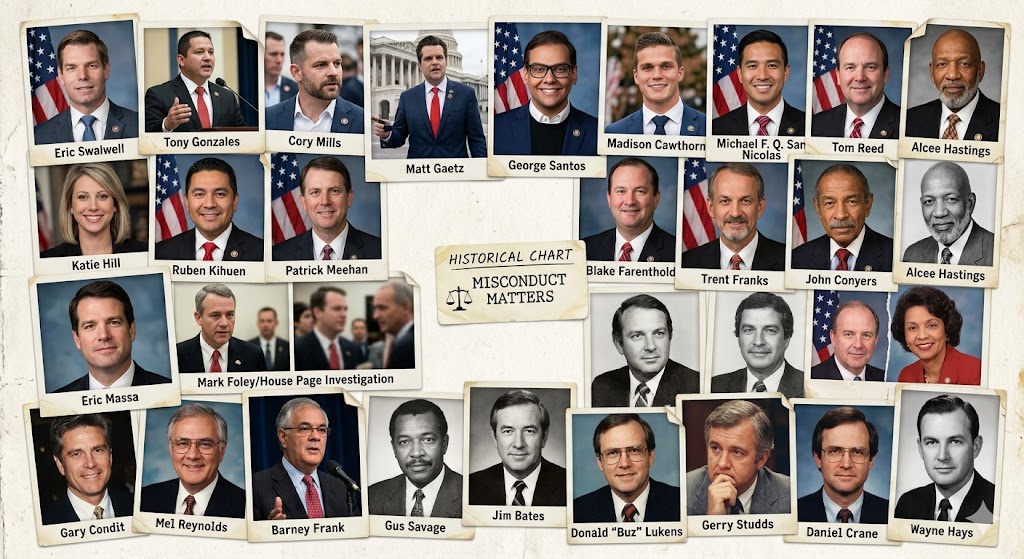
WASHINGTON D.C. — The House of Representatives is facing a historic reckoning. The number of publicly disclosed investigative matters involving alleged sexual misconduct has reached 28 cases. Some cases represent historical benchmarks. However, a recent surge in 2026 involving high-profile resignations has renewed calls for systemic reform within the House Ethics Committee.
The 2026 Crisis and Recent Findings
The momentum for transparency reached its peak after Tony Gonzales (R-TX) recently resigned. Investigations confirmed a sexual relationship with a staffer, leading to his departure. Inquiries into Eric Swalwell (D-CA) followed closely. His case involved alleged misconduct with a staffer. It also resulted in a “Loss of Jurisdiction” following his departure from the House.
Official List of Congressional Sexual Misconduct Matters
According to official House Ethics Committee records, the following 28 individuals or matters have been subjects of public investigative disclosures:
- Eric Swalwell (CA, 2026): sexual misconduct with staffer; Loss of jurisdiction.
- Tony Gonzales (TX, 2026): sexual relationship with staffer; Loss of jurisdiction.
- Cory Mills (FL, 2025): sexual allegations of misconduct/dating violence; Ongoing.
- Matt Gaetz (FL, 2024): sexual misconduct with minor/solicitation; Public report finding violations.
- George Santos (NY, 2023): sexual harassment of staffer; No violations found in this specific category.
- Madison Cawthorn (NC, 2022): Improper relationship with staffer; No violations found.
- Michael F. Q. San Nicolas (GU, 2022): sexual relationship with staffer; No violations found.
- Tom Reed (NY, 2021): sexual harassment of lobbyist; Loss of jurisdiction.
- Alcee Hastings (FL, 2020): sexual relationship with staffer; No violations found.
- Katie Hill (CA, 2019): sexual relationship with staffer; Loss of jurisdiction.
- Ruben Kihuen (NV, 2018): sexual harassment/lobbyist; Public report finding violations.
- Patrick Meehan (PA, 2018): sexual harassment of staffer; Loss of jurisdiction.
- Blake Farenthold (TX, 2018): sexual harassment of staffer; Loss of jurisdiction.
- Trent Franks (AZ, 2017): sexual harassment of staffer; Loss of jurisdiction.
- John Conyers (MI, 2017): sexual harassment of staffer; Loss of jurisdiction.
- Alcee Hastings (FL, 2014): sexual harassment of staffer; No violations found.
- Eric Massa (NY, 2010): sexual harassment of staffers; Loss of jurisdiction.
- Mark Foley (FL, 2006): sexual misconduct with House Pages; Loss of jurisdiction.
- Gary Condit (CA, 2001): sexual relationship with staffer; Law enforcement deferral.
- Mel Reynolds (IL, 1995): sexual misconduct with minor; Loss of jurisdiction.
- Barney Frank (MA, 1990): sexual misconduct involving prostitution; No violations found.
- Gus Savage (IL, 1990): sexual harassment during official travel; Public report finding violations.
- Jim Bates (CA, 1989): sexual harassment of staffers; Public report finding violations.
- Donald “Buz” Lukens (OH, 1989): sexual misconduct with minor; Public report finding violations.
- Sex and Drugs Investigation (1982-83): sexual misconduct with House Pages; No current Member violations.
- Gerry Studds (MA, 1983): sexual misconduct with minor; Public report finding violations.
- Daniel Crane (IL, 1983): sexual misconduct with minor; Public report finding violations.
- Wayne Hays (OH, 1976): sexual relationship with staffer; Loss of jurisdiction.
Moving Forward
The 2026 election cycle is progressing. The public is closely watching how the House addresses serious ethics allegations. Current investigations, such as the ongoing matter
involving Cory Mills, have become a primary focus for government watchdogs.
A recurring obstacle identified in the historical record is the “Loss of Jurisdiction” loophole. Under current rules, the Committee loses its legal authority immediately if a Member of Congress resigns. The same happens if they lose an election. The Committee cannot continue an investigation or issue a punishment in such cases. This often results in cases being closed without a final determination of guilt or innocence. It effectively allows individuals to avoid formal accountability by leaving office.
There is an increasing call for legislative reform. This reform would allow the House to finish its work regardless of a member’s employment status. Such reforms would ensure that all misconduct allegations are formally adjudicated and that a public record is established. By closing the “resignation loophole,” the House could ensure the truth is documented. This would provide the accountability that voters and ethics advocates expect.
Long story short: ITS TIME TO CALL OUT YOU FREAKY MFS AND GET YALL OUT OF THESE BIG SEATS!!!

Discover more from The Whitsdom Press
Subscribe to get the latest posts sent to your email.
Leave a comment